Wednesday, April 2, 2014

New Romanticists

I wish I knew how to quit you.
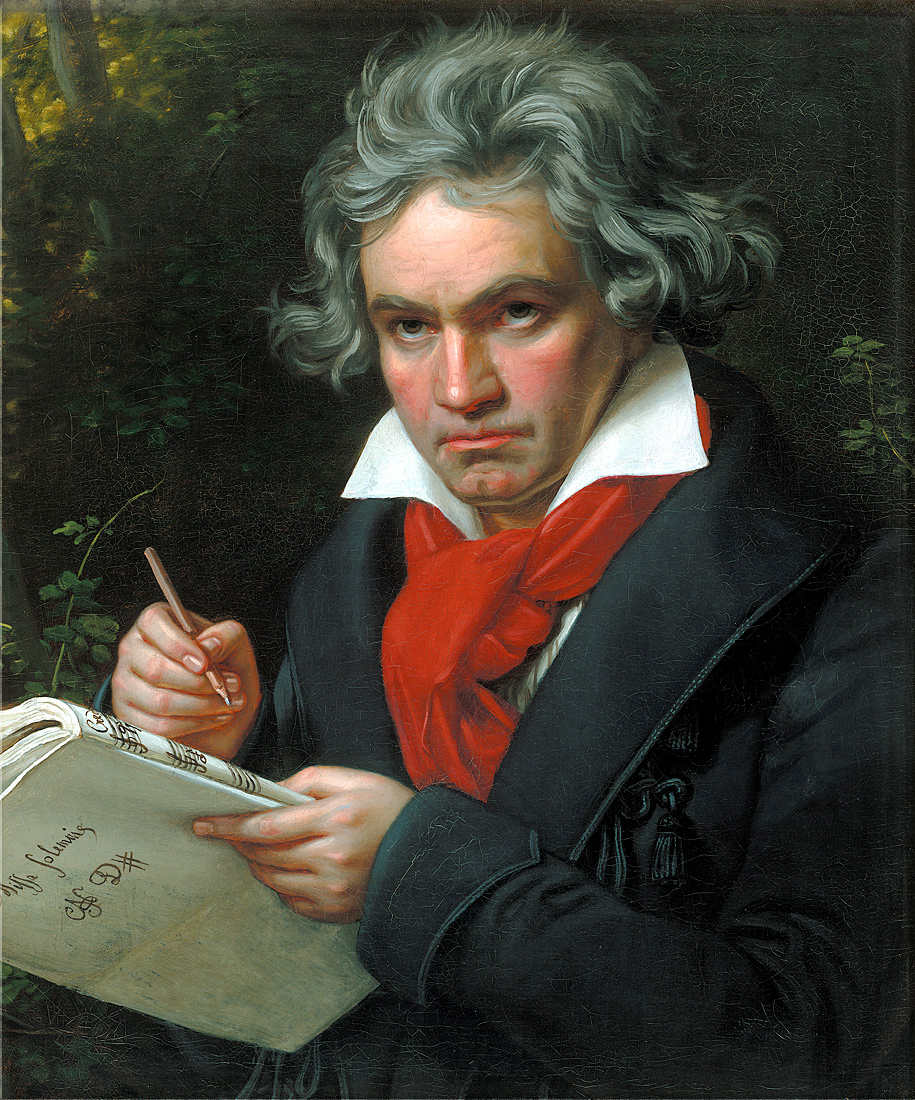
Ah, the New Romanticists. Rochberg. Crumb. Adams. Rzewski. These composers represent the sweet spot of my contemporary (or semi-contemporary) music preferences, and part of the core of my compositional influence. Time and again I realize how much I owe to these last strains of Romantic philosophy. I consider there to be two important aspects of my connection to this body of work: quotation and Transcendentalism. Already at this early stage in my career, I've explicitly quoted a Brahms intermezzo and a fragment of Bruckner's Ninth Symphony. And my desire for grand gestures, virtuosity, and emotional catharsis is completely in line with a tradition that reaches back to Barber and earlier. I sometimes feel embarrassed about my strong identification with Beethoven and how I sometimes sneak Beethovenian rhetoric into my music. As you'll see, all the composers I will examine below have strong connections with Beethoven, so I sometimes groan at myself for being yet another composer who just can't get over Beethoven.

Enough about me though (for now). I read an article from the ever-enlightening NewMusicBox about the history of the musical "look back", of composers consciously borrowing elements from the past. The author suggests that this falls into three categories: imitation, emulation, and quotation. Numerous examples from history support each category, but I'll focus specifically on the assigned listening for today. They are all obviously from the twentieth century, which makes them all the more fascinating; the twentieth century was the most risky time to attempt either a quotation or full-on imitation of older, tonal styles. The author offers Kyle Gann's take on this phenomenon: "Quotation allowed a return to tonality hidden beneath a veneer of irony; it offered a widened emotional palette without sullying the composer’s fingers in the actual writing of tonal or pretty music." That man has such a way with words.

Each of the pieces on this listening list employs quotation or imitation for a different reason. I'm finding it hard to organize my ideas here, so I'll resort to a list format:

George Rochberg - String Quartet No. 3
Quotation/Imitation: Imitation
Composer quoted/imitated: Beethoven, Bartok
Why: Rochberg started out as a serialist (and listening to one of his Bagatelles for Piano is proof), but after the death of his son he found that an atonal musical language was not sufficient for conveying his feelings.
Description: The Third String Quartet begins with a sharp, dissonant gesture, but the first movement passes through several sections of warm consonance that recall Beethoven's own string quartets, and some folky, energetic sections that bear striking similarity to Bartok. One of the primary motives in this movement is a tentative descending whole-step gesture that conveys Rochberg's indecisiveness about which style to settle on. Then in the second movement, we are treated to a full-on, fifteen-minute Beethovenian adagio. Rochberg produces a very convincing imitation of Beethoven's style, with lots of I-6 chords and angelic high violin lines, and in the same variation form Beethoven liked to use in these movements. Is this artistic resignation or cowardice? Or is it a daring, honest personal expression? The third movement begins with more Bartok, but revisits Beethoven again before ending on a Bartokian note. This piece, taken as a whole, is both a personal emotional statement and a view of the composer grappling with the string quartet tradition itself.

George Crumb - Black Angels
Quotation/Imitation: Quotation
Composer quoted/imitated: Schubert
Why: Crumb inserted the variation theme from Schubert's Death and the Maiden string quartet to add a sense of timelessness to an apocalyptic piece.
Description: Black Angels is a piece about destruction, death, and religious strife, written in a primarily dissonant and abstract aesthetic. The Schubert quote has a striking effect when it arrives unannounced after five minutes of some of the darkest, most disturbing music I know of. In the score, this section bears the text "Like a solemn consort of viols". This is interesting because it makes the quotation slightly anachronistic. If Crumb really wanted to emulate fifteenth-century viols, one would think he would use music from that period. But the Schubert quote just goes to show that certain musical constructions have a timelessness to them; the mournful, desolate quality of Death and the Maiden knows no historical limits. As the Schubert is played by three of the instruments, a lone violin hovers high above, like a last bird or insect surveying the ruins of civilization. This is honestly one of my favorite moments in all music. The effect is incredibly profound.

I should also mention that the movement headings in this piece ("Departure", "Absence", and "Return") are taken from Beethoven's Piano Sonata No. 26 "Les Adieux". Scholars have written in detail about the significance of using those titles to point back to Beethoven, but I think it's a bit of a stretch.

John Adams - Grand Pianola Music
Quotation/Imitation: Imitation
Composer quoted/imitated: Beethoven
Why: John Adams was trying to reflect his experiences walking through San Francisco Conservatory and hearing multiple piano students playing washes of arpeggios in pieces like Beethoven's Emperor Concerto. He also based this piece on a dream in which he was driving along Route 1 and saw two long black limousines transform into pianos playing arpeggios of E flat major and B flat major. Conveniently, E flat is Beethoven's heroic key and the key of the Emperor Concerto.
Description: This piece starts out in typical Adams fashion, with repetitive figures and static, suspended harmony. Eventually three wordless sopranos enter as a trio; they represent a group of three sirens (as seen in Greek mythology). It is not till the third movement that Adams goes full Beethoven on us (with dashes of Liszt and Liberace). This movement is titled On the Dominant Divide, and is full of bombastic progressions from I-V-I in different combinations. It ends resolutely E flat major.

Now, this piece has an interesting history. It was booed at the premiere, which, to be fair, was a concert of mostly academic, serial pieces from Princeton and Columbia. The audience probably interpreted it as some kind of lame, tacky joke. Adams did not intend this piece as a joke per se, but a parody for sure and a good-natured "Whitmanesque yawp". He was just being a little goofy, and could always fall back on the defense that he was just writing about his weird dream. I read somewhere that he deliberately tried to construct the most awful, clumsy semi-Beethovenian theme possible out of the I-V-I progressions. But the public doesn't always get highbrow musical humor, and this piece has been embraced by a lot of people who view it as a sincere Romantic statement. Isn't that wonderfully ironic? The most educated listeners may have gotten the joke, but they hated the rebelliously tonal trappings of the piece, and meanwhile the average concertgoer just gravitated toward the accessible harmonies while blissfully ignorant of Adams' intent.

Adams' own program notes from his website provide more insight into this piece, if you can put up with his usual self-aware, self-congratulatory tone.

Frederic Rzewski - The People United Will Never Be Defeated!
Quotation/Imitation: Imitation
Composer quoted/imitated: Imitation of classical variation form, especially the model of Beethoven's Diabelli Variations
Why: Somewhat open to interpretation, as I'll discuss below.
Description: I could write a long essay about this piece, but I'll try to be concise. Basically, Rzewski makes a clear Romantic statement with this piece. He writes an overwhelming set of 36 variations (on a Chilean protest song popular in the 70's) that surpasses the Diabelli Variations in complexity and duration, and, as if to acknowledge the Transcendental spirit of this endeavor, he includes an optional six-minute cadenza for the pianist to improvise. So much about this piece brings me back to Ives: the use of a popular patriotic tune for melodic content, a political element, shattering virtuosity, and extended piano techniques.

But there is more going on here than a simple appropriation of a Classical formal design. I see some kind of symbolism in the use of thirty-six short variations to portray a social struggle. In the same way that a large group of people would be heartily singing this tune, perhaps each variation is a portrait of a different individual involved in the conflict. Rzewski ends each set of six variations with a weird kind of retrospective, revisiting the textures and moods of each past variation in hasty, fragmentary fashion. What is he trying to say? That each of these people was killed or otherwise silenced by this oppressive regime? In addition to these possibilities, the improvised cadenza seems like an opportunity for the pianist to offer commentary on this political situation, or to choose which variations to revisit and meditate on. It's all very interesting.


Monday, March 31, 2014

Minimalism Part 2: Glass, and Performance Art Too

In my last post, I referenced an article by Kyle Gann about the history of minimalism and how it is perceived in different musical circles. In that same article he mentioned how, in an interview with Philip Glass, he confessed to the composer that he was "still trying to rewrite the Bed Scene from Einstein [on the Beach]." Philip Glass's response: "So am I."

That exchange intrigued me greatly, so I went ahead and found a recording of that particular scene. It was the first time I had really engaged with Einstein on the Beach, and I could instantly see why Gann was so enamored of this music. It is sublime from beginning to end.


Between this excerpt and the other parts I heard in a documentary, here's the first thing that stands out: Einstein on the Beach makes the best case for the synthesizer of any piece I've heard. It's a keyboard instrument, so it doesn't require much stamina to sustain arpeggios for minutes at a time, and because it has an electronic tone, somehow it remains detached from a perception as accompaniment. It just IS. The attack is always the same, with no decay, so it maintains the hypnotic quality Glass wanted in this music.

The documentary I watched was called Einstein on the Beach - The Changing Image of Opera. This was my first experience with the visual elements of the opera, and...wow. More sublimity. There was nothing alienating about it for me. I found the whole spectacle to be beautiful, ecstatically slow, and momentous. This is a piece about trying to get inside the head of a genius, experiencing thought and time from a different perspective, and meditating on genius itself and a celebration of genius and how it positively affects people. There is a futurist element to the opera, similar to the John Cage "happenings" that celebrated the arrival of the computer, but the total package is way more coherent and carefully crafted.

I facepalmed slightly at some of the interview scenes with Robert Wilson, the director and designer of the Einstein production at the Brooklyn Academy of Music. This man is such an Artist with a capital A, finding tortured, off-center positions in which to hold himself, smoking constantly, and talking in an over-meticulous way that suggests that he really likes the sound of his own voice. I imagine that as a collaborator he was exhausting to work with but also brilliant when necessary.
Look at those eyes. Seriously. Look at those eyes.

The interviews with Philip Glass, by contrast, illuminate his disarming sincerity and the light in his eyes. Anyone who thinks that minimalism, at least as produced by Philip Glass, is just a gimmick or a sham, needs only to watch this man speak to be proven wrong.

It's actually quite a joy to watch those interview segments interspersed with clips of the opera itself, because you can just feel the creativity and inspiration bursting forth.

I had a thought about why Glass-ian minimalism is so well-suited for the subject of Einstein. This music makes you THINK. An Elliott Carter string quartet makes me think, sure, but my brain is so busy trying to keep track of what's happening that I don't focus on what's happening moment to moment. In Einstein on the Beach, everything is repetitive: the pulses, arpeggios, vocal lines, dance movements. At some point it's all going to sink for the listener and maybe the listener will have some epiphany about the human race, math, science, joy, somewhat akin to what Einstein had in his life. It's also been proven that repetitive music like techno or dance pop (or Glass) can focus brainwaves, creating a conducive environment for deep thought.

Allright. That's probably enough geeking out over Einstein on the Beach for now.

Next I listened to an excerpt from Akhnaten - Amenhotep's funeral scene. The contrast was startling. Instead of abstract performance art onstage, there was clearly a story being told. It was also the most uptempo funeral music I've ever heard. I liked the effect of the fast music and the hearty unison singing from the ensemble, but it started to wear on me slightly. Still pretty cool.

I read an article by Timothy Johnson (an Ithaca professor whom I really want to talk to!) about the various definitions of minimalism and their inherent problems. He argues that the best categorization of minimalism is as a technique, as opposed to an aesthetic or style. He points to the explicit harmonic motion and large-scale design of a piece like Music For 18 Musicians; while it is repetitive and comprised of simple materials, it does have harmonic goals and musical development in mind. This is all to rebut the points put forth by people who try to put Reich and Glass under the same umbrella as La Monte Young, whose pieces arguably do not have these same formal considerations.

Johnson quotes John Adams and his take on minimalism as a personal influence: "Minimalism really can be a bore - you get those Great Prairies of nonevent - but that highly polished, perfectly resonant sound is wonderful." I love that! Great Prairies of nonevent. He seems to acknowledge that there's something very American about the movement: the openness, quiet positivity, the excitement of new beginnings, the catharsis and healing of simple consonances after a tumultuous time in history.

In a way, writing with minimalist techniques (I have to be careful here) must be uniquely satisfying for a composer. The listener is able to perceive almost every element of the piece's craft, and there's something miraculous about a piece that holds one's attention through the most subtle changes in rhythm or register or texture.

HERE BEGINS SECTION TWO: PERFORMANCE ART

I watched a breezy little video about the history of performance art, narrated by Frank Skinner, and in which I saw familiar figures like John Cage, George Macunias, and Yoko Ono. The video took an unexpectedly dark turn, though, delving into some of the most extreme performance art of all time, like a man submerging himself in some kind of black liquid in a bathtub for days, surrounded by excrement. Or a guy who zipped himself up in a tarpaulin and laid out on the highway. Or Marina Abramovic, who famously laid objects of varying potential for violence out on a table and invited the audience to use them on her. I think it's important that we live in a society where this kind of art is not the only kind of art, but I appreciate it for what it is. It makes us think about who we are, what's we're doing, and it creates a kind of vital, primitive humanness between the performer and the audience.

Next on the listening list were two pieces by Meredith Monk. The first one, Earth Seen From Above, confused me. It was a mesmerizing video of the International Space Station's view of Earth, sped up to a great degree. The underpinning music was a bit ambient and chill, based on a two-chord progression, and fit the visuals well. I guess I was expecting something that related more to performance art. But the visuals were stunning nonetheless. I saw flashes of thunderstorms flying past, the lights of cities, and most importantly, majestic views of the Northern Lights.

The other Monk piece was called Dolmen Music. Again, there was no video to accompany the music I heard, so I could only imagine what would be transpiring onstage. All that was provided was a still image of Meredith Monk in a semi-reclined position on the stage. The music was definitely beautiful, haunting, and poignantly constructed. Some extended vocal techniques played an important role, with many fast nonlingual syllables. The other musical materials I perceived were repetitive phrases, echo and imitation. Very beautiful stuff. I just wish I knew more about the context or meaning. I guess I'll have to seek that out.
Before Lady Gaga, there was this woman.

Then I watched a performance of Laurie Anderson's O Superman. This piece has an appealing facade, aligning itself with a pop idiom. It almost feels like an extended intro to some kickass 80's tune. I was basically waiting for the drums to come. But they never did. Anderson was wearing dark leather, her hair was wildly spiky, and she had exaggerated eyeliner. Together, these elements had a subversive effect. The song seemed pretty political, a commentary on American culture: "When love is gone, there is always justice/ and when justice is gone, there is always force/ and when force is gone, there is always mom". There were also repeated references to "the hand that takes". And the Ha syllable, repeated through the entire piece, seems more and more feeble by the end. I read about this piece on Wikipedia, and found that some of the thematic material is actually inspired by Massenet's opera Le Cid, so there's actually a lot going on here.

Ha ha ha ha ha ha ha ha ha ha ha ha ha ha ha...

Wednesday, March 19, 2014

Minimalism Part 1: Young, Riley, and Reich

This post will be heavy on personal experience and anecdotes, since with Reich we are entering into some of the music that has had the most powerful influence on my life.

I read an article by Kyle Gann about the birth of minimalism and its current place in music culture. He includes some comments from his personal experience, but he is allowed to because composers like Reich and Riley were just starting to gain momentum while he was in college! His whole relationship to minimalism has been heavily affected by the negative attitudes of the composition establishment; he was discouraged from attending a Reich ensemble concert in 1974, and even today he admits he is "marginalized in academic circles" for his enthusiasm for minimalism. I'd have to say I feel the same way after certain conversations with my composition professor...

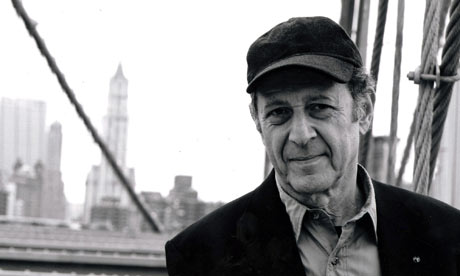
A classic photo of Reich. Probably my favorite.
Let me talk about my experience with Steve Reich. I remember, as a young high school kid, browsing my local library's classical CDs and randomly picking up a recording of Music For 18 Musicians. I had unusually good luck in unknowingly picking masterpieces - previous blind picks included Ives' Concord Sonata and Rachmaninoff's Piano Concerto No. 2. When I first listened to the Reich CD, I thought it was chill (almost too chill) and sort of pleasant background music. But after hearing it live in Chicago twice (played by eighth blackbird and friends) and then once at IC, I have a new perspective. This piece is, first of all, one of the most beautiful things ever written. And that beauty comes not just from the sounds themselves, but also from the interplay of the musicians and the commitment they have to make to each other for the piece's hour-long duration. Musically, it conveys the excitement and spontaneity of city life. The gentle grooves and the timbres of mallet percussion instruments bring to mind sleek skyscrapers instead of green pastures. This music is nourishing, meditative, healing, and necessary.

Piano Phase is another piece with both musical and conceptual beauty. Any decent pianist can sit down and play the little phrase, and maybe get a friend to attempt the phasing part. I got to try this once with another pianist at a new music event in Brooklyn, during a downtime when people were just milling about. We didn't get very far, but it was fun to hear some of the sparkle once the parts slowly go out of phase. Another great thing about this piece is that it's pretty damn clear what's going on. The audience goes through the thought process of "Is this all there is too it? Oh, now it's phasing. Is that really going to hold our attention, though? Oh WOW. This is cool." There's also a sense of Beethovenian triumph here. Reich starts out with a simple little piano figure and achieves incredible, mind-altering effects by the end.

There's a video on YouTube of a guy playing both parts by himself. That is hardcore.


Now on to La Monte Young. I listened a to a good chunk of his opus The Well-Tuned Piano, and I'm somewhat conflicted about what I heard. The sounds are undeniably beautiful. Each note has a unique color and character. The minor intervals are profoundly plaintive, and the whole piece has a slow, languid beauty. But is it enough? Young's aim seems to be inducing a hypnotic state, but I've heard music in experimental tuning that strives for more structure and variety. Michael Harrison, a regular at the Bang On A Can Marathon, has an hour-long piano piece called Revelation in just intonation. He reveals the tones slowly and methodically, but it eventually grows into a piece of epic scope. Harrison has written a lot in this tuning system, and perhaps my favorite is Just Ancient Loops, for amplified cello and tape. It ends with the most spine-chillingly awesome chord I've ever heard (24:13). There is so much potential in just intonation, and I think it's only a matter of time before it sneaks its way into adventurous pop music. Seriously.


I listened to another La Monte Young piece, an excerpt from Map of 49's dream the two systems of eleven sets of galactic intervals... Aside from the brow-raising title, this piece is simply a high drone. The timbre of the drone changed slightly over the course of seven minutes, but that was it. I didn't mind it, but I also didn't really enjoy it.

Finally, I should mention Terry Riley, since In C is one of the very earliest minimalist pieces. This has even more of a communal vibe than Music For 18 Musicians, since the players have to keep listening to each other and judge when it's the right time to move from one phrase to the next. It's cool how the piece can be over in 5 minutes or 45. I prefer longer versions.

Monday, March 17, 2014

Politics and the Avant-Garde

Well, I'm back from spring break. After finishing my latest assigned reading, I am happy to personally know the author...

In my earlier discussion of John Cage, I mentioned how he was primarily occupied with pieces that had no explicit political statement to make. In this reading, however, I learned about his anarchist beliefs and his very intentional efforts to simulate anarchist musical utopia within at least one piece: the ambitious and theatrical HPSCHD. Ironically, this piece celebrates the computer (a novelty in the 60's) even as it strives toward utopian ideals. Perhaps in the 60's there was still positive energy surrounding the new technology, rather than the Big Brother/NSA paranoia of the present day.

Cage meant nothing less than for this piece to "prepare" his audience for a larger revolution in art and which would result in a utopian, anarchist society where everyone contributed and there was no overriding ethical system. Something deep inside me cringes at these kinds of proclamations. The idea of a utopian society driven by art sounds amazing, but I shiver at the unfamiliarity of the situation and at the near-impossibility that such a thing could happen. I bristle at the sheer radicalism of the 60's counterculture; I can't imagine what the electricity of that period felt like. Maybe that same reaction of repulsion is the same reason I had trouble all through my childhood and early adulthood allowing myself to completely enter into a church worship setting. I was afraid of being radically changed.

It's interesting to ponder these ideas while knowing that there's at least one intentional community right here in Ithaca (the EcoVillage).

From what I could glean from the description, HPSCHD is a rebellion against concert-music conventions but also a modern answer to Wagner's gesamtkunstwerk. The piece has no perceptible beginning, multiple unrelated events play out on the stage, and music is only part of the total spectacle. In contrast to Wagner, who held tight singular control over his artistic projects, the gesamtkunstwerk of HPSCHD is the result of the efforts of many artists from different fields collaborating. Additionally, Wagner's operas had political uses, making a case for the superiority of the Aryan race and for the Holocaust, whereas Cage's work aligns itself with no government or race. Copland said of this phenomenon: "What Cunningham, Cage, and company make amply evident is that the Wagnerian model for collaboration is not the only model - indeed, today, not even the dominant model". In the excitement and rapid changes of the 60's, maybe this joyous cooperation did feel like the beginning a new age. What happened?

One thing that really stood out to me about HPSCHD, and which points back to this idea of cooperation, is the fact that the audience was allowed to walk around the room and view different elements of the performance as they wished. I see this as a poignant act of understanding from one artist to another. Composers have always had the disadvantage of working in an art form that has a fixed duration (usually) and has a fairly static visual element. If the audience is allowed to create their own visual experience of the performance, and supposedly to come and go as they please, the musical elements are on the same level as the visual art elements.

HPSCHD. Welcome to the future.
 
I watched a clip of an actual performance of HPSCHD, and I was surprised at how much it all made sense even just from my detached perspective. I saw the whole scene, underpinned by pleasant harpsichord music, as a quirky but inviting manifesto of Cage's whole anarchist movement. The anachronistic music both gives it a sense of timelessness and conveys a sense of order. The visuals I saw in the clip were mesmerizing: undulating blobs of color on video screens and flashing lights. For the two minutes that I watched, I felt a childlike glee and a sense of hope in composers and artists who dare to push boldly forward and try to create societal change with their art.

Monday, March 3, 2014

Conceptualism

The first required reading for Conceptualism was absolutely fascinating. Early in the text I read a description of a performance of "Originale" by Stockhausen, a ninety-four minute extravaganza that comes across as the closest thing to Wagnerian gesamtkunstwerk that the avant-garde scene has yet produced. Performances of this piece included group improvisations, recitation of poetry, film projections, and live animals. Stockhausen even had one part written for a particular composer/performance artist, Nam June Paik. That detail points to the avant-garde scene's embrace of the agency of the perfomer, but as I read futher into the text I started to see the conflicts inherent in these composer-performer relationships and in the scene itself.

Catherine Moorman, a cellist, describes how she grew bored of her life as a mainstream classical performer, daydreaming in the middle of her own solos. And therein lies the paradox. Musicians become bored of the predictability of the classical canon, so they migrate to the world of new music. But there they have to deal with potentially extreme intellectual and physical demands, forceful composer personalities, and a smaller audience, that, while attracted to this music, may still not understand or enjoy the work of a particular composer. New music does not have the protective seal of retrospect. It has not been exposed to audiences for enough time for a definitive critical opinion to form, or for an enthusiastic following to develop. Performers are usually taking a risk in learning this music, because it may not be worth the trouble. Only time will tell.

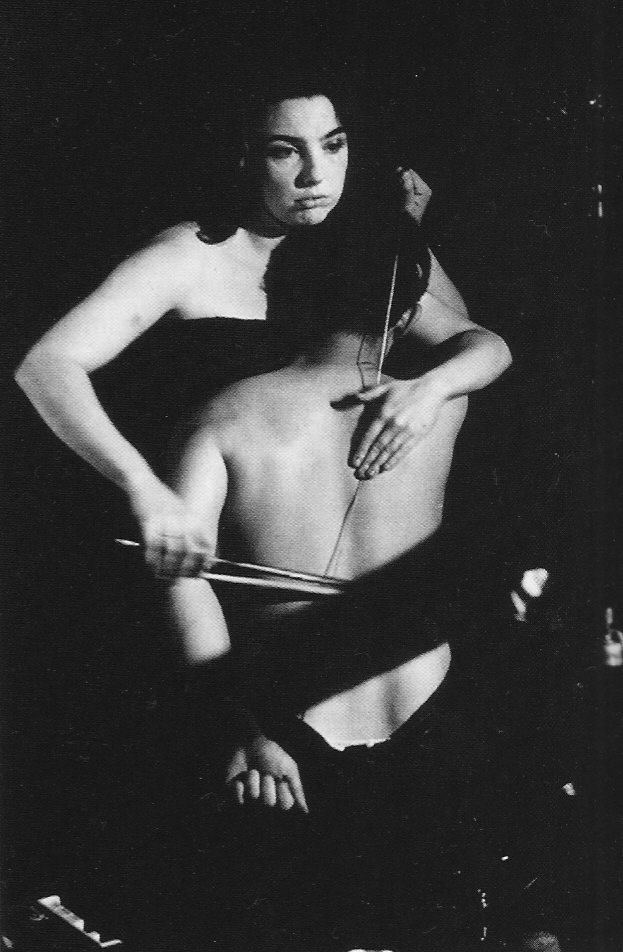
Catherine Moorman plays Nam June Paik as a human cello.

The other conflict is between the composer's desired outcomes for a piece and the actual outcomes in performance. John Cage apparently had some major issues with Catherine Moorman's performances of his piece 26' 1.1499". Though she worked diligently, she incorporated some erotic and explicit physical actions (along with the hijinks of Nam June Paik) that pushed Cage's boundaries. Here we see the tension between Cage wanting to let performers have free rein over his work, but also not wanting them to get carried away with infinite possibilities.

I briefly perused the Fluxus Performance Workbook. Fluxus, of course, is the larger movement surrounding John Cage and the downtown Manhattan scene in the 60's, built on anti-art, anti-government ideals and some Dad influence. This workbook contains hundreds of conceptual chance pieces that are simply lists of instructions to produce a performance, or in some cases, an action that is not even performed on stage, like mailing a treasured item to someone....or peeing on subway tracks. Pretty far out. I don't know what to think of the more impractical concepts. Would there be any value in actually carrying out those instructions? For example, dragging a bunch of broken dolls along a street would not be interpreted by the average person as a piece of performance art. But it might make them think about things. And maybe that's the point?

I watched a video of Pauline Oliveros' piece "Teach Yourself to Fly". The premise is that any number of people sit in a circle in a dimly lit room and start to breathe, slowly introducing pitch and then increasing in intensity. The results were quite beautiful and unearthly. I'm sure that the feeling of being in that room would be akin to a religious experience, electric and confusing and scary and thrilling. And I think that's what Oliveros was aiming for: something to take people outside of the everyday realm and into a slightly higher plane.

Next I listened to James Tenney's Chromatic Canon. A New York Times profile on Tenney notes that he has worked in a large variety of media and styles, from highbrow electronic music to film scores and ragtime. He's a true maverick. This particular piece combines a minimalist aethestic with a slowly building 12-tone row. The piece maintains a very calm, consonant sound for the first minute and the first four or so pitches of the row, but then dissonances intrude and the soundscape becomes really unsettling, even mind-altering. I wanted it to stop but at the same time I was hypnotized. I'm glad I listened to the end because eventually the tone row was stripped back down to the opening consonant pitches, returning to an equilibrium.

I had the unique privilege (?) of hearing Alvin Lucier's I am sitting in a room live at the Bang On A Can Marathon in 2012. Coincidentally, Pauline Oliveros and her Deep Listening Band were also present. This piece really tests my patience, but I appreciate the concept. Lucier reads the following text:

I am sitting in a room different from the one you are in now. I am recording the sound of my speaking voice and I am going to play it back into the room again and again until the resonant frequencies of the room reinforce themselves so that any semblance of my speech, with perhaps the exception of rhythm, is destroyed. What you will hear, then, are the natural resonant frequencies of the room articulated by speech. I regard this activity not so much as a demonstration of a physical fact, but more as a way to smooth out any irregularities my speech might have.

There he is.

It's kind of awesome that the concept of the piece is clearly stated in the text that is the piece itself, so the audience knows exactly what's going on. Because wow, it happens so gradually. By the last few minutes (after about forty minutes), Lucier's voice has transformed into plangent ambient sounds with musical pitches. The experience of hearing this live was pretty memorable, partly because the room in question was the Winter Garden at the World Financial Center, a huge, resonant rotunda. The other neat aspect was the changing light through the enormous window overlooking the Hudson River. It was late afternoon, and the hazy sunlight filtering into the room enhanced the feeling of melting into the room.

The Winter Garden at the World Financial Center, New York, where the Bang On a Can Marathon is held.

The last piece I listened to was Atmos by Joan La Barbara. It was interesting enough but not my favorite. It begins with sampled human sounds and sound effects, and then introduces instruments like flutes beginning around the five-minute mark. By the end there is a beautiful, tribal effect produced by the voice freely improvising with the instruments.

Wednesday, February 26, 2014

Graphic Notation

Every one of my encounters with graphic notation has captured my imagination. I remember the first time I opened the score to John Cage's Aria, Cornelius Cardew's Theses, and Cathy Berberian's Stripsody. The latter was especially meaningful because it contained actual illustrations of daily life and familiar human concerns. Though the score is meant to be performed by a single singer, I was captivated by the idea of a whole orchestra meditating on those images. The thought took me to a childlike place of glee. As I prepare for my upcoming graphic notation project, I'm certain that I want to use some literal representations of life alongside abstract shapes and symbols, to give the piece a programmatic framework.

I read an article from the excellent website New Music Box about an upcoming (well, in 2008) collection of graphic score samples in book form, meant to chronicle that particular development in music. One of the featured composers, Alison Knowles, has created, among other things, a score comprised of onion skin peelings scattered across a sheet of paper. I love the concept, both for its use of renewable, organic material (I'm sounding like a real Ithacan here) and for the quasi-mysticism of its process; music as divination. But Knowles said something in an interview that really affected me: when asked if she has any expectations about the outcome of her performances, she said: "I like to be really surprised". I think that statement gets at the core philosophy of the graphic notation movement. Perhaps many of these composers get more joy from the infinite musical potential of a visual concept than from a score that dictates every pitch and articulation. Sometimes it's more satisfying and stimulating to be surprised by the results of an experiment than to hear a good performance of our work in which we can predict every second of the proceedings.

Additionally, graphic notation opens up the realm of music to children, or anyone who has not been trained to understand standard music notation. I'm sure there are thousands of people out there who have something to express through music, but they find the standard systems too rigid or need a more open-ended stimulus.

I spent some time looking at score samples from the new collection mentioned on New Music Box. There is a nice dedicated website up and running where I was able to peruse to my heart's content. I was surprised to see that some of the scores still feature a 5-line staff and normal notes. They do, however, break the mold in other ways. One of the most uninspiring at face value was just a bunch of thin lines drawn across a blank sheet of staff paper, with some blue shading at the bottom. One score was an image of the solar system, with duos, trios and quartets between different groups of planets. Cute. And one of my favorites had a few different tuplets in interlocking circles, like a Venn diagram, surrounded by colored circular splotches. I liked staring at that one and contemplating the implications of the materials on the page.

Not the original image from the Notations 21 website, but this is at least part of the score.

Graphic notation has a really interesting psychological effect. The academic in me is stimulated by graphic possibilities in relation to my knowledge of musical gestures and textures, but the child in me responds to the visceral shapes and figures, and whimsy of seeing a stuffy system bent and twisted into something more playful.

Monday, February 24, 2014

The New York School

There is a quotation early on in David Nicholls' essay on The New York School (concerning visual art and music), which itself is taken from a John Cage article, that made me think for a while: "Cowell remarked at the New School before a concert of works by Christian Wolff, Earle Brown, Morton Feldman, and myself, that here were four composers who were getting rid of the glue. That is: where people had felt the necessity to stick sounds together to make a continuity, we four felt the opposite necessity to get rid of the glue so that sounds would be themselves." This is a daring endeavor, because it puts a lot of responsibility in the hands of the performers. John Cage's Music of Changes, for example, lacks precise metric notation; clusters of notes are scattered around long, empty staves, allowing for many different approaches to the pacing and execution of the piece. To take this idea a step further, Cage also stressed that the music should be free of intention. WHOA. That's the really radical idea, because what it does is eliminate (to some degree) the composer's ego. Composers can get so caught up in specifics of notation and worrying about public perception of a piece, but Cage and his friends were telling themselves and composers outside their circle to LET GO. But this approach is also strangely paradoxical, because first of all, even if the pitches and rhythms produced by chance procedures are free of an outside context, the piece as a whole bears the distinct intention of being a piece of chance music, and a sort of a musical experiment. Maybe I'm being too nitpicky.

The commentary on composer Earle Brown in the this article intrigued me; Morton Feldman apparently described him as an important link between American and European music in the twentieth century, and that several composers ripped off his techniques. I listened to Brown's piece 4 Systems first, and I found myself conflicted about my opinion. At face value, the music held little value for me, but then I remembered I needed to LET GO and take the music on its terms as an experiment. Luckily I was able to view the score; I would say that the success of this music hinges almost entirely on being able to view the composer's graphic score (ironically the same approach I have to ultra-complex composers like Elliott Carter and Kaikhosru Sorabji). The recording that I listened to struck me as boring, but looking at the score I kept telling myself that the pianist was simply not being creative enough with the material. Earle Brown specifies in a footnote that the thickness of marks can indicate either clusters or dynamics. This particular pianist went for the clusters. I would be interested to take this piece into a practice room and see what kind of interpretation I would come up with.

Earle Brown's piece Folio was slightly more interesting to listen to, as I heard a definite continuity with certain motifs. I didn't have the score handy for this one, but it wasn't a great loss. I still would like to know what it looks like.

Brown's program notes for both these pieces are surprisingly academic and dry. Maybe he was actually very intellectual, but these notes seem like a conscious attempt to appear hyper-intelligent to hide insecurity.

Next I listened to Morton Feldman's Rothko Chapel, and it was beautiful. Maybe it seemed more beautiful in contrast to the Brown pieces, but I feel like I really "got it". I looked up images of Rothko Chapel to aid in the experience. It was nice to see musical and visual factions of the New York School complement each other. I was surprised at the abrupt ending of the recording, but then I realized that there was MORE. Much more. This made me happy. I'll have to listen to the whole thing in one sitting some other time.

Rothko Chapel, Houston, Texas.
This piece bears some marks of conventional compositional technique. Besides the obvious tonal centers and perceivable meter, Feldman paces his instrumentation skillfully so that the choir entrance is a real revelation. The overall atmosphere of the piece is meditative, but ominously, mysteriously so. I think this fits the intent of the Rothko Chapel building; it is a space designed for meditation and non-denominational spirituality, but its dark, minimalist layout may lead one more to ponder the question of God's existence and other deep questions about life.

The other Feldman piece on the listening list was King of Denmark. I've looked at the score to this before, and I found a sample online:


Within the grids are different specific musical events. This system has slightly more composer control than Earle Brown's 4 Systems. The events are also more spaced out, so the listener can focus on each one. This piece is not my absolute favorite, but it is a nice exploration of a percussion setup.

I listened to a couple of Christian Wolff's Exercises (18 and 3). Another instance in which I wish I had the score. It was hard to tell which elements were strictly notated, if at all, and which were chance elements. I heard some recurring ostinati, and the the musical language was unified. The feel was alternately jazzy/bluesy and improvisatory. It was fun to hear a saxophone in a piece of concert music, since I just finished writing a piece for alto sax.

Last but not least in this section is Christian Wolff's Long piano. I looked up some program notes for this and found that he was partially inspired by a certain piece of artwork: a 154-foot long sequence of almost 1000 silk-screened enamel plates. He also mentions that the piece contains many quotations, from "L'homme armé" to Schumann's Kinderszenen. I am usually drawn to very long piano pieces, and this is no exception. I must say the opening movement did not overly impress me; it meanders in a free, organic way, but gives little sense of the massive scope at hand. I'll have to spend an evening with this one and follow it to its end.