Monday, February 17, 2014

American Modernism

Ugh, American Modernism. I'm in a pretty cynical, dismissive mood for this one, not just because I'm a composer and composers like to be hypercritical of music they don't like, but also because I'm experiencing a pretty huge crisis of my own artistic endeavors. Composition has been an increasingly frustrating and unrewarding struggle, and I'm seriously questioning whether I should be doing this shit anymore.

So here it goes.

I've given Elliott Carter's music a try. I really have. In my undergrad years I remember several times that I checked out the scores of all of his string quartets from the library and listened to each one multiple times, hoping to gain some real insight and find a lasting pleasure besides just marveling at some of the incredibly complex rhythms and virtuosic string lines. At this point, I do appreciate the First Quartet and understand its importance to music history; it was Carter's first big experiment in metric modulation (after his cello sonata), it contains sections that give the impression of simultaneous but unrelated events, and the language is fresh but loosely grounded in a sense of logic.

Mozart, Schubert, Mendelssohn and Gershwin all died before they were 40.
But this guy just kept on living...

But the rest of the quartets escape me. Their most unique elements are impossible to perceive without a score in hand or with a live ensemble in front of you. I know that Quartet No. 2 has each musician simultaneously playing different material, conveying very different moods, for the entirely of the piece. It's a fascinating idea, but the results are surprisingly unsatisfying. For the twenty-minute duration of this piece, there is not one consistent motif or rhythmic idea to latch onto. The relentless unpredictability of the music becomes, ironically, predictable. One only perceives slight textural changes, and the most palatable parts are the slow sections, where Carter's harmonies are presented in slow motion and can be processed by a human brain.

The Boosey and Hawkes complete edition of Elliott Carter quartets has an introductory essay by the first violinist of the Juilliard Quartet, where he talks about the process of rehearsing and playing these pieces. He claims that they provided him and his fellow musicians with some of the most thrilling performance experiences of their lives. I can imagine the adrenaline rush of responding to other players with laser-beam precision to nail all the polyrhythmic textures, and being as intimate with the music as possible. But do music critics or the general public say that being at an Elliott Carter concert was one of the most exciting or impactful events of their lives? Do people converse about these string quartets and say "Oh, I love that one passage that goes like this...."? Absolutely not. So this music seems to be for everyone except the audience. Elliott Carter enjoyed writing it, I suppose, though this music must have been exhausting to live with and to edit, and the musicians can enjoy the pride of mastering some of the most complicated music ever written. But this whole stream of music travels further and further into complete irrelevance, away from the heartbeat of humanity.

Roger Sessions leaves me similarly ambivalent, but his Third Piano Sonata is easier for me to grab onto than the Carter quartets. This piece has an attractive first movement that strikes a nice balance between Impressionism and blues. The textures are definitely pianistic, and he throws in some chunky Ivesian chords. His Third Symphony has the advantage of orchestral colors and some discernable motifs, so it's easier to follow through the long haul. Still not very fun though.

Milton Babbitt's essay "Who Cares If You Listen?" makes me really freaking angry. In summary, he states that because of the trend in contemporary music toward heady academism, it should be relegated to the world of academia and created only for people who will fully understand it. What irks me so much about his conclusion is that he seems so self-satisfied, so assured in the security of his musical movement, not wondering if maybe it is just a brief phase. He forgets that at one time music was actually created to stir the heart, not just the mind.

I read Claudio Spies' essay on the appreciation of Schoenberg's music, but I have nothing to say about it. I just can't care about it right now.

Hopefully my next post will be less informed by personal concerns and the turbulence of my mood swings. Tonight I'm signing off with a clip from The Lawrence Welk Show, which is the complete opposite of American Modernism in both its functionally tonal music and its portrayal of a naive innocence that never really existed anywhere, but which I long for sometimes when life becomes too much to handle.


Monday, February 10, 2014

Aesthetics of the Avant Garde

I read an essay by Arthur Danto called "The Abuse of Beauty". This piece attempts to approach art through a philosophical lens, referencing figures like Kant and Hegel, and commenting on the intersection of natural beauty and artistic beauty.

One section of the text stood out to me: a discussion of Jesus in art. As a former Christian in the process of trying to make a comeback, I had never realized the significance that Jesus' suffering, as depicted in art, is a very ugly thing at face value. This is a man being whipped, nailed to a cross, and hung up to die a slow death. Of course Christians see the beauty behind all of this, because of what the crucifixion means (or perhaps because they become desensitized to the images of torture after years in the church). The Passion of the Christ, the ultraviolent film that follows the events of Jesus' death, and little else, is the epitome of this torture as art. Danto's essay mentions how representations of the crucifixion in art have varied in severity over the centuries, as a reaction to different public taste. In this way Jesus' crucifixion is almost like a weathervane for artistic taste in general, because it the most universally accepted artistic subject that happens to also be "ugly".


Because violence is so central to the story of Christianity, it makes sense that Christians seem to have no problem with endorsing films like Saving Private Ryan or Gladiator, because all the violence has a noble cause at its root. They identify with those violent struggles, and it ends up informing their critical taste. At the same time, they are extremely cautious about movies portraying sex, even if it is good and healthy intercourse between a married couple. Sex is simply more taboo than violence in Christian culture.

When it comes to my own taste in art, especially music, I CRAVE dissonance. It satisfies me like food. Does that make me weird? Danto would argue no. He is of the opinion that after many artistic boundaries were shattered in the twentieth century, certain personal tastes that were formerly on the fringe entered the mainstream.

But it all relates back to the revelation that anything can be beautiful. A still life of flowers is beautiful, sure, but so is a photo of unemployed adults during the Depression selling apples on the street, because STRUGGLE is beautiful. And when we recognize those humans qualities in art (struggle, survival, desperation), we make an empathetic connection.


We should also keep in mind that the goal of art should be to provoke any number of emotions. This is a difficult situation, though, because a piece of art created for mere shock value, with empty content, provokes anger in the viewer; the viewer feels manipulated. But we should find equal joy in engaging with art that pleases us and art that makes us uncomfortable or unbearably sad. It's a romantic sort of ambition: feeling the full of spectrum of emotions and just being excited to feel.

This Danto essay is one I'll be rereading a lot. I feel that I can't adequately respond to all the deep philosophy at the moment, but as it sinks in more perhaps I'll offer more thoughts.

Wednesday, February 5, 2014

Partch, Johnston, and Nancarrow

Harry Partch is probably the most purely radical composer, and person, that we have discussed so far. All of the distinguishing elements of the previous composers are present in Partch, but taken to the extreme. He disliked Western culture and high society, so he spent a significant amount of time as a vagabond, living the low life with other wanderers on the edge of daily sustainability. I love one of the passages from Ben Johnston's profile "The Corporealism of Harry Partch: "...after his hobo years he just had no fear of society or its opinions. It had done its worst to him, yet he was still going; so in a large part he had won his freedom." I really admire this quest, in a detached sort of way, since I strongly desire a similarly enlightening experience but would never be able to do it myself. After doing this, he must have felt even more disconnected from the manners of concert music. In his own words: "'The presumptions that lie behind the art of this culture are no good for me. I'm going to start all over and make something I can live with.'"

Amen, brother.

Partch even rejected the avant-garde circles of the time, thinking them too much a product of overcivilized minds. That's about as independent as a composer can get. And of course he famously created his own instruments in different tuning systems. I admit I have never listened to his music, but it's never too late to start.

One other comment that ties Partch back to the avant-garde discussion: he remarked that perhaps preserving recordings of his music would represent the definitive form of his art, since it would be nearly impossible (and inauthentic) for someone else to recreate his painstakingly handmade instruments. This is the complete opposite of our initial discussion about the avant-garde and experimentalism; for Partch, building the instruments was the experiment, and the part that could not be replicated. The music itself was meant to be played in a definitive way.

Listening to Barstow for the first time was a somewhat disappointing experience. I was expecting a mind-expanding homemade instrument, but I only heard a guitar, albeit in an interesting alternate tuning. This piece seems to belong more to a folk tradition than anything. The musical material is pretty conservative and repetitive. The concept of the piece is nice, though: drawing attention to the stories of the types of people society forgets, but that Partch must have been intimately involved with. The closing movement is sort of a dramatic peak, since the text is the most desperate and it covers several psychological moods.

I highly enjoyed the website where one can "play" Partch's instruments. I felt like I understood him much more after hearing the quirky tones of different marimbas and kitharas.

Next I listened to Ben Johnston's String Quartet No. 4, specifically the Amazing Grace movement. This was also harmonically conservative - but only for the first half. Then is devolved into a glorious exploration of timbres, rhythmic development, and it took on an epic scope. There was definitely an element of Ivesian transcendentalism in this piece, in taking the most familiar hymn tune and finding something new and noble to do with it.

Johnston's Suite for Microtonal Piano didn't make a huge impact on me. I heard evidence of great craft, and the alternate tuning did allow for more expressive timbres than a normal piano, especially in higher registers (and particularly in movement 4). But I don't think these devices were used as creatively as Ives in his Three Quarter-Tone Pieces, which include effects like glissandi between two pianos. That said, the Suite for Microtonal Piano is still a very appealing piece.

Conlon Nancarrow's music is usually a fun listen. He parallels Cowell in his exploitation of the piano. I had heard some of the player piano studies before and got familiar with their dense textures and rhythmic complexity that are clearly unplayable by a human. In these two studies though, I heard some new effects. No. 25 is full of super-fast arpeggiated chords that become quite annoying after a while, but are redeemed by the wonderfully insane ending. The piece ends in a flash of colors.

I had to take a deep breath at the beginning of No. 36, which contains basically the same arpeggiated chords. Maybe this music caught me on a bad day, but it was just tiresome to me. The cross-rhythms were fascinating, though, and I enjoyed the complete liberation of the piano from traditional timbres. It ended up sounding semi-electronic and full of sound effects, almost like an arcade game. Seriously. I think Nancarrow had a prophetic vision of kids in the 1980's playing Space Invaders. Or Asteroids. Maybe?


Monday, February 3, 2014

Cowell, Antheil, Varèse, and Crawford Seeger

Reading sections of Henry Cowell's New Musical Resources provides a nice contrast to Ives' Essays Before A Sonata. While Ives was writing about philosophical ideas and how to unite the head and the heart in music, Cowell was precise and scientific. In attempting to bring recognition to the overtone series and its potential in composition, he gives some concrete examples of chords that produce strong overtones and includes a chart. Some of this information was startlingly new to me, and I felt almost embarrassed that I had not investigated overtones already. Cowell matter-of-factly states "If we take the first six overtones [of a C major chord], we arrive at the following chord: C, E, G, G sharp, B flat, B, D, F". I couldn't believe this. I actually sat down at the piano and played all those notes together. It was even more exotic than I expected. Unfortunately I was playing on the electric piano in my apartment and could not experiment with actual acoustic phenomena.

Henry Cowell's overtone chart.

Cowell also gives a whirlwind tour of pioneering techniques in music since Monteverdi, beginning with the statement "It has become popular to assert that most great composers were accepted fully in their own time, and that many of them did not introduce new material". Of course his ensuing discussion of Monteverdi, Bach, Mozart, Beethoven, Wagner, Liszt, and Debussy shows just how forward-looking they were in different ways. All of this rhetoric not-so-subtly prepares us to accept Cowell's techniques as the next step. The rest of the text concerns other musical devices like quarter-tones (where he gives a shout-out to Ives), sliding tones, and research into undertones, which blew my mind a little more.

After reading all of this heady stuff it was relieving to listen to two Cowell pieces I had heard before, but several years ago. "Tiger" is a great starting point to examine Cowell's work with overtones. He alternates textures of aggressive tone clusters with pauses that let overtones swirl into the air. Each of those moments was really magical. The tones are like musical ghosts, so ethereal and hard to pin down. It is also worth noting that this piece is more concise and unified in its material than a typical Ives piece.

"The Banshee" brings back great memories of my roommate, Nathan, in my senior year of undergrad, who learned to play this piece. I saw firsthand the logistical ordeals of practice and performance; since it is played entirely on the piano strings, Nathan brought little colored tabs with note names to the practice room and painstakingly placed them on the strings to keep track of the notes. He also became easily tired from awkwardly hunching over the sounding board. But he said something really enlightening about the piece: "It's frustrating sometimes as a pianist because we are so detached from our instrument. We sit at the very edge of it and play. But woodwind players and string players get to embrace their instruments. And when I play The Banshee, I sort of get to do that."

That said, The Banshee is an incredible piece. Nathan played it well but never quite like what I heard on the recording. I seriously thought I was hearing tremolo strings at the beginning. The sounds are intense and have wild psychological effects. I love how Cowell experiments with different intervallic possibilities. I heard some thirds near the 2-minute mark that produced absolutely wonderful colors. This piece is really quite terrifying in a way. It is true to its name.

It was humbling to read a compilation of bad reviews of Cowell's performances. Many of the phrases from those reviews surely have a place in Slonimsky's Lexicon of Musical Invective. My favorite was "[he] spanked his instrument in chunks of tone". I suppose the point of all these reviews is point out the difficulty of being both a pioneer and a good-quality composer, to unite experimentation with craft. Cowell, just like Ives, probably felt the weight of trying to move music forward while also trying to write good pieces to demonstrate new techniques, and to accept that perhaps no one would really understand it yet.

What I took away most from Christine Fena's piece on Cowell was how shocking it must have been for audiences to see the piano opened up and played on the strings or the wood. Some of these techniques have become almost cliché in contemporary music, but the horror and disgust of seeing that legendary instrument "boxed" by Cowell must have been incredibly uncomfortable.

George Antheil's Ballet mécanique features some of the most purely mechanical piano writing I know of. Antheil embraced the futurism movement of the early twentieth century, in which artists celebrated machines and things in motion. Sure enough, the video for this piece includes many spinning objects, a woman on a swing, and industrial images. The ensemble, with its repeated patterns and nonstop motion, becomes a sort of machine, but it's a very festive machine, with the occasional siren like a fanfare.

Everything moves in Ballet mécanique.
I started playing Varèse's Ionisation and thought "The sirens are back!" Though this is still futurist music, it has a more sophisticated texture than Ballet mécanique. The percussion writing is quite spectacular; this was a turning point in percussion history for sure. At times the writing borders on controlled chaos, but other times it simply explores complex divisions of the beat.

I was not familiar with Ruth Crawford Seeger at all before this, but I'm glad I am now. Her piece Piano Study in Mixed Accents sounds like it was written yesterday, but now I understand that in her time she laid the groundwork for future composers like Carlos Sanchez-Gutierrez and others who concern themselves with constant motion and offbeat accents. I will have to investigate more of her piano music.

Wednesday, January 29, 2014

The Concord Sonata

Charles Ives's Piano Sonata No. 2 "Concord" is not just any piece. This piece has consumed my imagination ever since I first listened to it in high school, and over the ensuing years I have slowly attempted to learn to play it, while also researching the background of the piece and investigating every corner of Ives's output.

I have visited this spot many a time.

I have often said that this piece is as beautiful for its concept as for the execution of that concept. In four movements Ives portrays the spirit of four writers who lived during the Transcendentalist movement in New England in the mid-nineteenth century. This was a movement that emphasized the basic goodness and decency of people, and organized religion and government were seen as a threat to that purity. Ralph Waldo Emerson, the subject of the first movement of the sonata, crystallized the general feeling of Transcendentalism in an 1836 speech: "We will walk on our own feet; we will work with our own hands; we will speak our own minds... A nation of men will for the first time exist, because each believes himself inspired by the Divine Soul which also inspires all men."

Of the four writers, Emerson was the most important to Ives. This is evident in the fact that the Emerson section of the sonata also existed as a piano concerto and an overture, and that Ives continuously tinkered with this movement, claiming that it was never quite finished.

Nathaniel Hawthorne is an odd choice of subject for the second movement, since he was actually opposed to Transcendentalism. He believed all men were inherently evil, and most of his stories focus on Puritan guilt. Thus, he serves as sort of a foil.

The third movement is titled "The Alcotts", referring to Louisa May Alcott and her family. In the context of the sonata, this represents the idea of simple living; Louisa's parents were involved in a Transcendentalist community living experiment called Fruitlands, and Louisa's literature illuminates the joy of the common life.

Finally, Ives closes with a movement based on Henry David Thoreau, who also valued simple living but took it to the extreme, retreating into nature for a prolonged period. By ending with Thoreau, Ives makes the intriguing statement that perhaps the answers to some of life's deepest questions lie in nature.

Now on to the music. The Concord Sonata is very cyclical, with short themes that appear in every movement, in varying transformations. It traces a path from extreme dissonance and density to absolute clarity at the end of the Alcotts movement, before returning to austerity for Thoreau. It is difficult to describe the music itself in great detail, but I did write some program notes when I performed the Emerson movement on my junior recital at Wheaton. Here's an excerpt:

"From a performance standpoint, the Concord Sonata presents a unique set of challenges. Any serious performer approaching the score is likely to be baffled by Ives's footnote: '…there are many passages to be not too evenly played and in which the tempo is not precise or static; it varies usually with the mood of day…a metronome cannot measure Emerson’s mind and oversoul, any more than the Concord steeple bell could'. The writing is dense, often notated in three or four staves, and a certain Yankee ingenuity is required to account for every note in Ives's massive chords. In keeping with the Transcendentalist spirit, the sonata is intended to be a virtuosic tour de force, an American answer to Beethoven’s Hammerklavier. Indeed, the piece rivals Beethoven's great sonata in its motivic saturation (with fragments of Beethovenian themes, no less!), and in its exploitation of both percussive and textural piano effects. The second movement contains passages of tone clusters to be played with a strip of wood, and the final movement briefly requires a solo flute.

The fact that the Concord Sonata still sounds radical to our ears today is a testament to Ives's imagination and artistic courage. Right from the outset, it explodes with barbaric chords and polyrhythms. The opening four notes of Beethoven's Fifth Symphony appear repeatedly, with many different harmonic and psychological implications. Ives conjurs up a tour de force of sound: grinding dissonances that seem to scream from the keys, distant church bells, splashing arpeggios. There are moments in which all the little themes piles up on top of each other, like several people trying to talk at once, only to dissolve into some kind of grand Transcendentalist statement. Ives lovingly captures the chaos and awkwardness of American life, a wackiness that cannot be notated in 4/4 time or arranged in neat diatonic harmony. The fact that the Concord Sonata still sounds radical to our ears today is a testament to Ives's imagination and artistic courage. The piece still bears the label of 'difficult music', but I do agree with Lawrence Gilman's assessment of its greatness*. I hope you enjoy the ride."

I will quickly address the companion readings to this piece before this post becomes too unwieldy. First, Ives's own Essays Before A Sonata are a great demonstration of his brilliance, not just in music, but as a thinker. In the Prologue, he hits the reader with one weighty question after another, mostly about the idea of portraying concepts and/or concrete objects in music. He poses these questions about evaluating the success of programmatic music even as he is writing an extremely highbrow programmatic piece.

The piano at the Alcotts' Orchard House.

The short essay about The Alcotts brings a very important point to light; he mentions the spinet piano in the Alcotts household "on which Beth played the old Scotch airs, and played at the Fifth Symphony". Here he makes the connection between the simplicity of the New England household and the revolutionary spirit of Beethoven, because in the nineteenth century, a typical American's first experience with the classical canon would be not in the concert hall, but in the home. In this way the seemingly plain lifestyle of these people touches on something bigger, more immense, even divine. And at the end of the Alcotts movement of the sonata, as the Beethoven theme rings out in rich, triumphant C major, this quotation from the essay summarizes the effect: "All around you, under the Concord sky, there still floats the influence of that human faith melody, transcendent and sentimental enough for the enthusiast or the cynic respectively, reflecting an innate hope— a common interest in common things and common men—a tune the Concord bards are ever playing, while they pound away at the immensities with a Beethovenlike sublimity, and with, may we say, a vehemence and perseverance—for that part of greatness is not so difficult to emulate."

One last point to make about that particular movement is that, in the process of laying out his artistic philosophy in this piece, Ives also makes a case for tonality as an arrival point. After two movements of the most hardcore dissonance, the climax in C major feels incredibly majestic, because it is earned.

Kyle Gann's essay concerns Henry Brant's orchestration of this piece, which I had the privilege of hearing live in Chicago. In some ways the orchestration is a great gift; being able to hear orchestral colors and notice melodic lines that were previously hidden in the texture has helped me greatly in my piano interpretation. But the piece also loses something as a symphony. The piano is a solo instrument, and as such the most intense moments are really visceral, bursting with virtuosic derring-do. When I perform the climaxes of Emerson, Hawthorne, or The Alcotts, I have to give my entire physicality to the music and pour my heart into it as well. The experience of hearing a performer's struggle to victory in this music is more electric than hearing a whole orchestra. It's that kind of piece, and I think that's the way Ives intended it.

It is now quite late. Hopefully I will be able to adapt some of these thoughts to my presentation tomorrow, and also play some excerpts convincingly.

*In another part of the program notes I included a quotation from Lawrence Gilman's review of the public premiere of the piece, where he recognized it as the greatest music ever composed by an American.

Monday, January 27, 2014

Ives and His Contemporaries

Ah, Charles Ives. This composer is dear to me in so many ways. The first reason is more personal than musical; Ives spent most of his life in Danbury, Connecticut, which is just 20 minutes north of my hometown. As an Ives fanatic, I have visited every relevant site, from his birthplace to his grave to a mountain where he once built a shack for composition retreats. When I walk through the woods of Connecticut and drive down country roads lined with historic churches and colonial-era houses, I feel a special kinship with Ives's music. I understand where his inspiration came from.

Me at the summit of Pine Mountain, where Ives used to sit and contemplate nature.

But Ives means more to me than that. His music is a near-perfect representation of America, vacillating between aggressive, boundary-shattering dissonances and retreats to nostalgia. These two styles are often in conflict, even in the same piece. Ives loved patriotic tunes and the hymns of church traditions, and he gleefully inserted fragments of these songs into his music wherever possible.

For now I'll refrain from talking about the Concord Sonata, which is absolutely my favorite piece of music and which I consider one of the greatest pieces ever written. The introductory listening for Ives was Three Places In New England and The Things Our Fathers Loved.

It seems a bit strange that Three Places In New England has become the go-to Ives piece to program in an orchestral concert. It is not completely audience-friendly. The first movement, also the longest, does not have much interest beyond some lush string chords and tasteful dissonances in the piano (always a part of Ives's orchestra). But when we get to Putnam's Camp, it is vintage Ives (though, knowing both the Concord Sonata and the Fourth Symphony, I experience major déja vu at the opening). The polyrhythms are fascinating, and the evocation of an out-of-control marching band is quiet novel. All the patriotic tunes would come across as pandering to the audience if they weren't wrapped up in such a sophisticated framework.

The final movement, The Housatonic at Stockbridge, most completely captures the New England spirit of this piece. Ives takes one of his best art songs and adapts it to an orchestral canvas, and the effect is extremely exciting. Muted strings run up and down in the background like a slight breeze, hinting at possibilities. The vocal line is played by the cellos, and dissonant notes on the glockenspiel trickle into the ear. I've read that this piece was composed shortly after Ives's marriage. He and his wife shared an intimate walk along the Housatonic River, talking about the future that lay ahead of them. I love the fact that Ives captured this moment and then orchestrated it, magnifying it. It reminds me of the dialogue surrounding the pivotal wedding in Thornton Wilder's Our Town, as the townfolk speculate on another young couple getting married. By getting married, they get a glimpse of the profound, transcendental truths underlying the quiet life in their town. I think that what Wilder did in that play is exactly what Ives did in his music: examining the simple, common decency of people and taking it to a place of exaltation.

Since I think it's worthwhile to compare the original voice-and-piano version of The Housatonic at Stockbridge with the orchestral version, here are both versions back-to-back. I wish I could find an online version of Jan DeGaetani singing this, but alas, this will have to do:


And the orchestra:


The other Ives piece on the list was the song "The Things Our Fathers Loved". In this piece I hear more of that deep American nostalgia, and also Ives's penchant for employing the whole-tone scale and sometimes touching on a Scriabinesque mysticism.

Carl Ruggles was a contemporary of Ives, but I don't know nearly as much about him, aside from the fact that Ives supported him. At a concert of Ruggles' piece Men and Mountains, Ives noticed many hecklers in the audience and said something to the effect of "Don't be afraid of strong music like this  - use your ears like a man!"

Unfortunately, Ruggles does not hold a candle to Ives. Sun-Treader is modernistic and pioneering for its time, but there is a distinct lack of personality. Even though Ives can sometimes be opaque and frustrating to listen to (even by a self-proclaimed fanatic), there are unique trademarks of his style: quotations, distant bells, manic ragtime breakdowns. There is a sense of philosophical reasoning behind the music. Ives always wants to get a message across.

If there's one advantage Ruggles has over Ives, it is that his music sounds "cleaner" and that it is being played from a well-edited score. Ives left much of his scores in complete shambles, with incoherent marks and differing editions that gave publishers headaches. But this can be attributed to the fact that he was essentially an amateur composer, writing in the evenings after he returned from selling insurance, and also from the fact that he disliked the whole classical music scene.


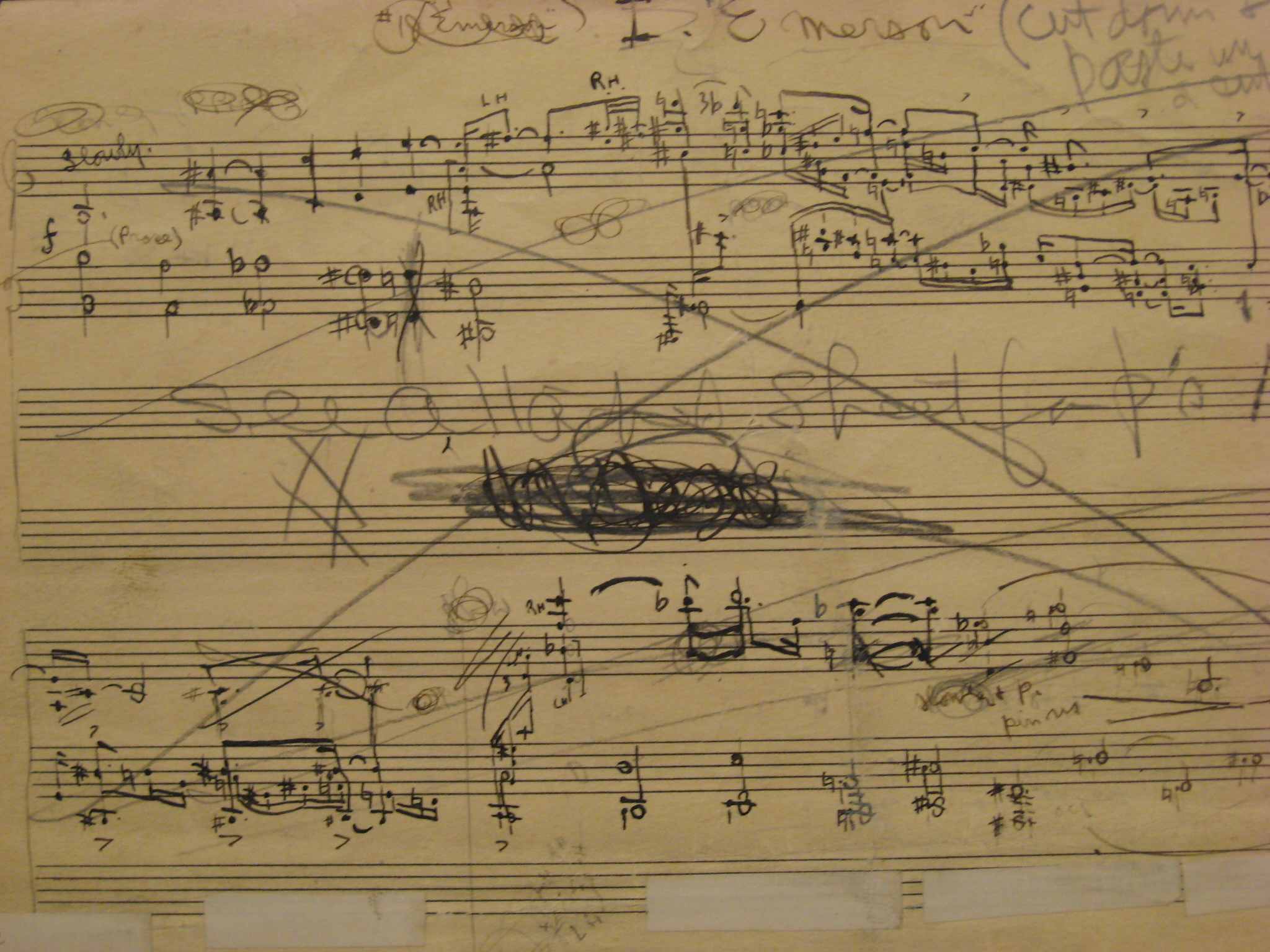
 The messy manuscript of Ives's Concord Sonata.


This post has only scratched the surface of Ives and what he means to the American canon. Next time I will attempt to write about the Concord Sonata.


Wednesday, January 22, 2014

"Experimental" vs. "Avant-Garde" Traditions

Definitions are incredibly important to musical discourse and are often subjects of great controversy. As a composer, when I am asked the dreaded question of "What kind of music do you write?" I face a bit of an identity crisis. I could say that I write "art music" or "concert music" or "contemporary classical music". That last one always leaves a strange aftertaste; while it is comforting to identify with a tradition that is hundreds of years old, I also wonder why I feel the need to identify with it. Why not another musical tradition? Or a new one?

Composers of experimental or avant-garde music have struggled to define their music as well. What exactly is the difference between "experimental" and "avant-garde"? Are they the same?

My understanding is that "avant-garde" is a more general term, while "experimental" refers to some specific musical techniques that have become staples of that repertoire. The phrase avant-garde, according to Grove Music Online, first appeared in a military context, to describe one group clearing the way for the rest of the troops. Indeed, composers like Charles Ives and John Cage were pioneers in their fields, taking bold risks that paved the way for future composers to follow. The musical avant-garde has taken many forms, from serialism to Dadaism, but it has always been the cutting edge of musical developments, especially ones that may not really be accepted or understood until years down the road.

Reading Michael Nyman's piece on the definition of experimental music, I realized why this music is so revolutionary. While an average composer may experiment with a scale, a motif, or an instrumentation, experimental music focuses on experimenting with every possible parameter, most of which are completely outside of theoretical considerations, like the autonomy of the performer. Composers like Cornelius Cardew produced graphical scores (thereby experimenting with the parameter of notation as well) which freed the musicians to interpret the markings however they wished. In other pieces, a performer might be encouraged to tap or slap parts of his or her instrument or integrate vocals.

Experimental music has strong roots in philosophy. During the performance of a piece with chance procedures, the question arises: What is music? What is the life of music? For many of these pieces, the music lives and dies in each performance, because it will never be exactly the same twice. Recordings do not adequately capture these pieces either, because a recording only contains a single audience and musicians reacting to the particular circumstances of that performance. There is something profound about how the composer relinquishes a large amount of control in a piece with indeterminate elements. Lots of power is transferred to the performers, and the composer can only try to be happy with the results.

To reach a conclusion about the definitions, I believe that avant-garde is a broader term than experimental, because experimental music is just one category of pioneering, future-anticipating art. The experimental music movement that began in the twentieth century was characterized by several distinct compositional techniques, and while they may not be as specifically avant-garde as they were decades ago, they still distinguish this body of work.